
Does anyone wonder why the open web has the challenges it does? I keep coming back to a very old piece of industry furniture: the LUMAscape.
When LUMA first started mapping the market, the open web was a lot smaller. The landscape was always quite big, but it was readable. It gave you a visual representation of the competitive opportunities, some idea of who the players were and a place to start looking for the best deals and capabilities.
That was the difference between the open market and the closed platforms. You had choice.
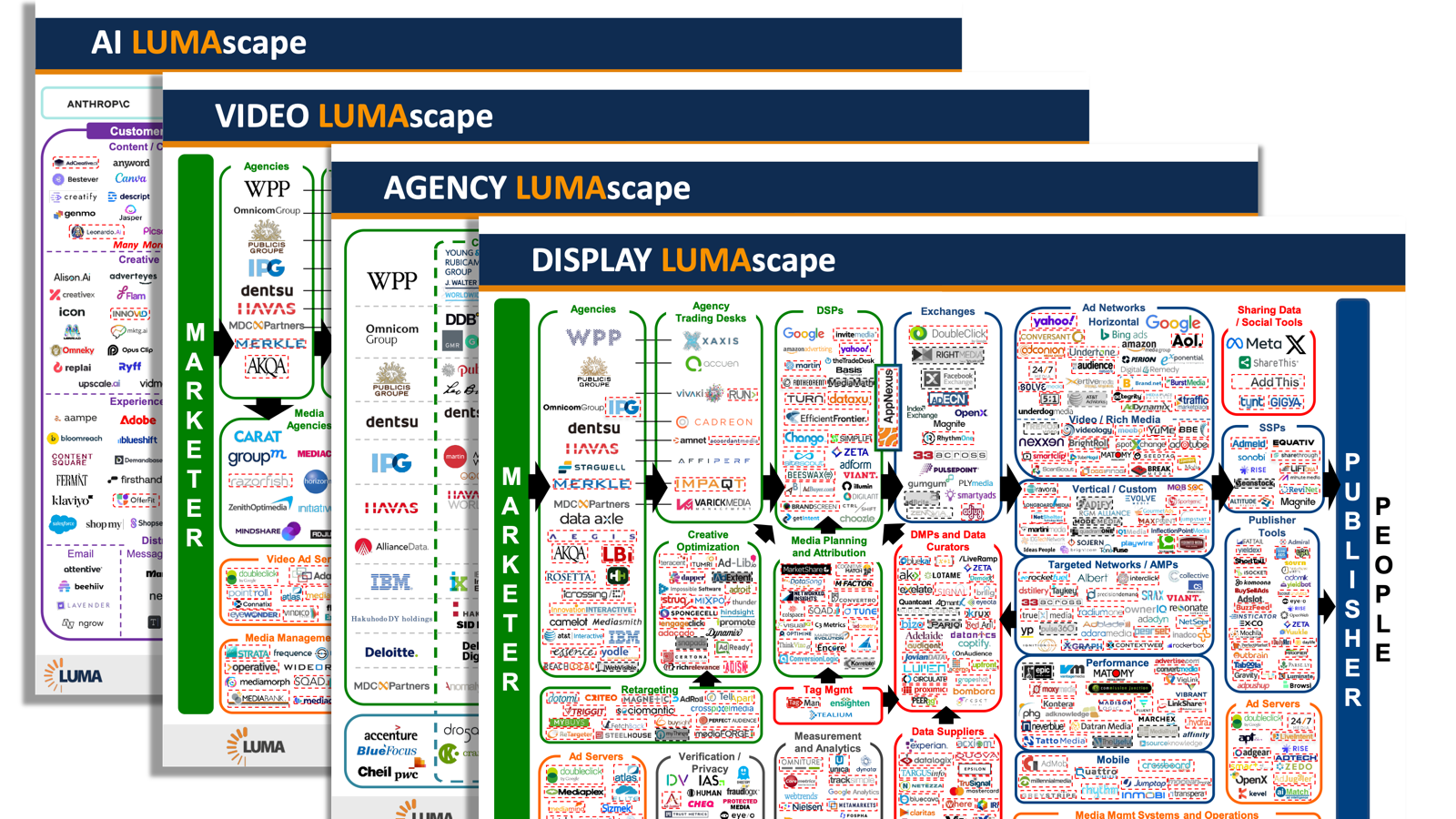
Now try buying it
An advertiser coming into programmatic today is looking at an entirely different world. The barriers to entry became so low that the LUMAscape turned into a seascape, full of companies I wouldn’t touch with a barge pole if I were a new advertiser.
Dare I say it: to a new buyer, the open web looks like a shit show. How on earth are they supposed to work out who to use?
Everybody arrives with familiar promises: agnostic integrations, scale, performance, perhaps a guarantee if you read the small print. Meanwhile the LUMAscape that everybody once loved to pop into a presentation is now a series of slides you can’t read because the logos have to be so small. What was a competitive advantage has become a massive disadvantage. At points it is almost meaningless.
Somewhere inside all of this, an agency or its client still has to decide who to use. Find the data and the audience. Pick a DSP, then decide which SSPs matter. Do you need verification? Specific creative options? DCO? Which measurement company should be involved? Do you need an ad server, a video specialist or an AI company? Who manages the creative?
The list is endless and every company on it wants a slice of the media dollar.
The technology tax nobody discusses
Compare this with a walled garden. Nobody sits down with Meta and starts a long conversation about the technology tax. It all comes under one roof. The platforms aren’t immune from controversy—quite the opposite—but they get shit done.
Reporting is taken care of. Creative optimisation is in the platform. With Meta you can get very close to saying, “This is the outcome I want,” and leaving almost everything else to the machine. You may not like how much control you have surrendered, but the operational proposition is obvious.
Over on the open web we’re still arguing about protocols, auction mechanics and whose standard should win. We want transparency, except when somebody asks what full transparency would reveal. There is wastage, another MFA scandal, accusations that money is being filtered out, and a supplier somewhere explaining why its fee isn’t really a fee.
“Your fees are too high” is often a proxy objection. So are many of the arguments about supply paths and hidden technology costs. They grow because performance is hard to ascertain. If a buyer could see clearly what worked, the useful intermediaries could defend their economics and quite a few others would disappear.
Direct routes around the middle
I asked in the previous essay whether the open web was dying. The numbers say it isn’t. A $63 billion US programmatic market in 2030 is not a dead market. The harder question is how many of the people currently standing in the middle will still deserve to be there.
Advertisers now have more ways to go directly to a publisher. Brands can do it themselves. Publishers with scale can package their audiences, data, creative and measurement into something much easier to buy. In truth, most of the major ones are already becoming small gardens of their own.
I don’t think the core infrastructure disappears. DSPs add enormous value. SSPs do too, and some of the data and measurement vendors are genuinely important. But there is a reckoning coming—or rather, there needs to be one. A company that adds another hand-off, dashboard and fee without improving the outcome is going to find it much harder to exist.
The walled gardens don’t win because advertisers love walls. They win because somebody gets the job done.
The long tail will struggle. Publishers with scale will behave more like platforms. Existing walled gardens will raise their walls and new entrants such as OpenAI already look quite comfortable building their own. None of this removes the need for an open alternative, but it makes the old sales pitch about choice much less convincing.
The open web will continue asking which protocol it needs, where the money leaked and whether somebody’s fee is too high. A buyer eventually stops waiting for the industry to settle those arguments and chooses the route where the job simply gets done. Quite a lot already have.