
I’ve spent more time than is healthy trying to work out where US digital display money actually goes.
Robin Bell’s updated media money flows at Quo Vadis is the sort of industry analysis I like. It takes a market full of overlapping forecasts and forces the money into a picture that can be argued with.
I wanted a narrower answer. Strip search out of US digital advertising and where does display spend end up: inside the large closed environments, with publishers directly, or on the open web through programmatic pipes?
This sounds easier than it is. You can lose several hours deciding where YouTube belongs, separating Amazon search from display and working out whether direct-sold CTV is publisher direct or video. I probably did.
A narrower cut
The model starts with published 2025 and 2026 estimates for US digital display, then reconciles every dollar across three broad destinations. Closed environments include Meta, Google display and YouTube, Amazon, and other controlled ecosystems. Publisher direct gets its own line. Open-web programmatic is split between connected TV, online video and non-video display.
Where published forecasts extend to 2028, I’ve used them as a bridge. The 2030 view applies explicit growth assumptions to each category and reconciles back to the total market. It’s a forecast, not an audited set of accounts, and every classification can be challenged. The decimal places are a side effect of Excel, not confidence.
Published inputs: EMARKETER, Inc. (2026), including its US digital ad spending, company, search, publisher, programmatic display, video and CTV forecast series. Category definitions, calculations, estimates and extensions to 2030 are Goode Media Consulting’s.
In 2026, the model puts US digital display at $232.9 billion. Open-web programmatic represents $43.2 billion of it, or 18.6%. By 2030 the overall market reaches $358.5 billion and the open web reaches $62.6 billion.
Follow the share
A $19.4 billion increase is hardly a collapse. Plenty of markets would be delighted with roughly 9.7% annual growth. The problem appears when the open-web number is put back into the whole market: its share falls to 17.5% by 2030. Closed environments move the other way, from 75.9% to 77.5%.
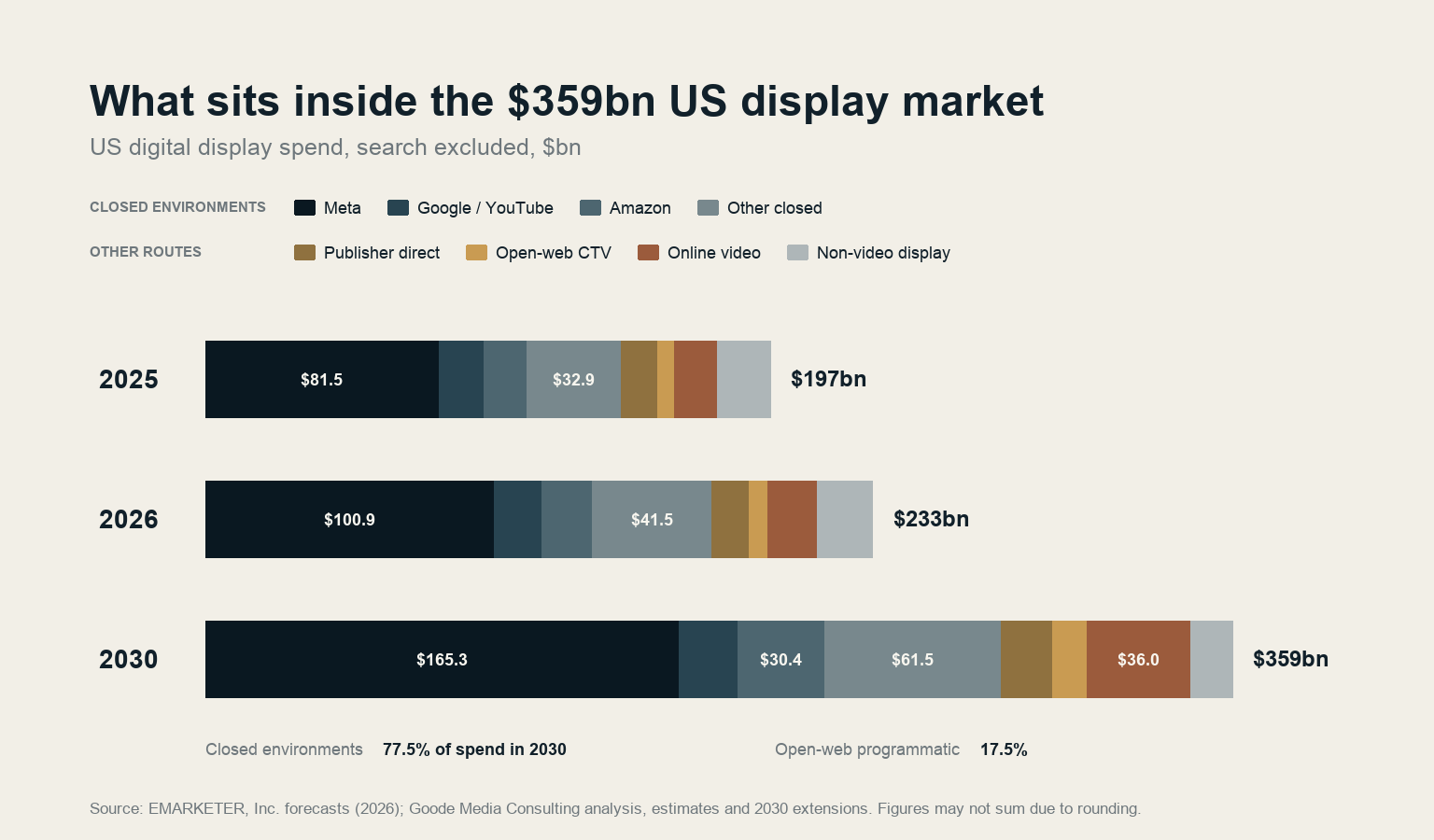
Open-web programmatic grows by nearly $20 billion and still loses share. The numerator is growing; the denominator is growing faster.
This is why a presentation showing the growth of “digital advertising” can be accurate and still be fairly useless to an open-web business. The relevant part of the market isn’t growing at the same speed, and the gap compounds.
Meta, in context
Meta is responsible for the number that made me go back and check the spreadsheet. Its US display revenue rises from $100.9 billion in 2026 to $165.3 billion in 2030, an increase of $64.4 billion. The entire open-web programmatic market in 2030 is $62.6 billion.
One company therefore adds more display revenue than the forecast value of all open-web programmatic at the end of the period. It accounts for just over half of total market growth on its own. Taken together, the closed environments capture about four of every five incremental dollars between 2026 and 2030.
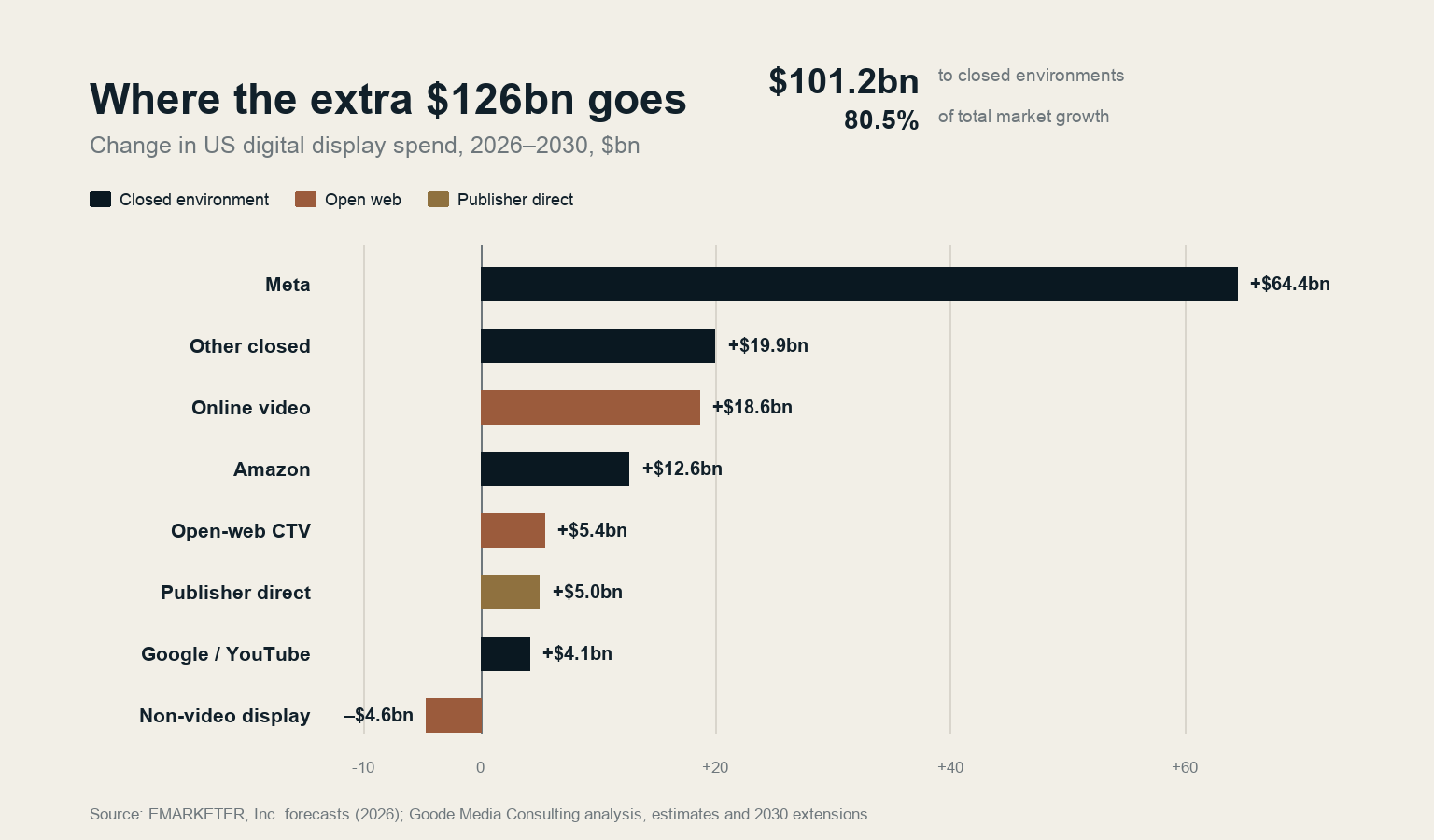
Forecasts can be wrong, of course, and Meta’s growth is an assumption rather than destiny. But a strategy for the open web needs to make sense if the broad direction is right. Pointing at total digital growth and assuming a fair share will arrive isn’t much of a plan.
Look inside the $63 billion
The composition of the open-web market changes more than the total suggests. Non-video display falls from $19.3 billion in 2026 to $14.7 billion in 2030. Online video grows from $17.4 billion to $36.0 billion, while open-web CTV moves from $6.6 billion to $12.0 billion.
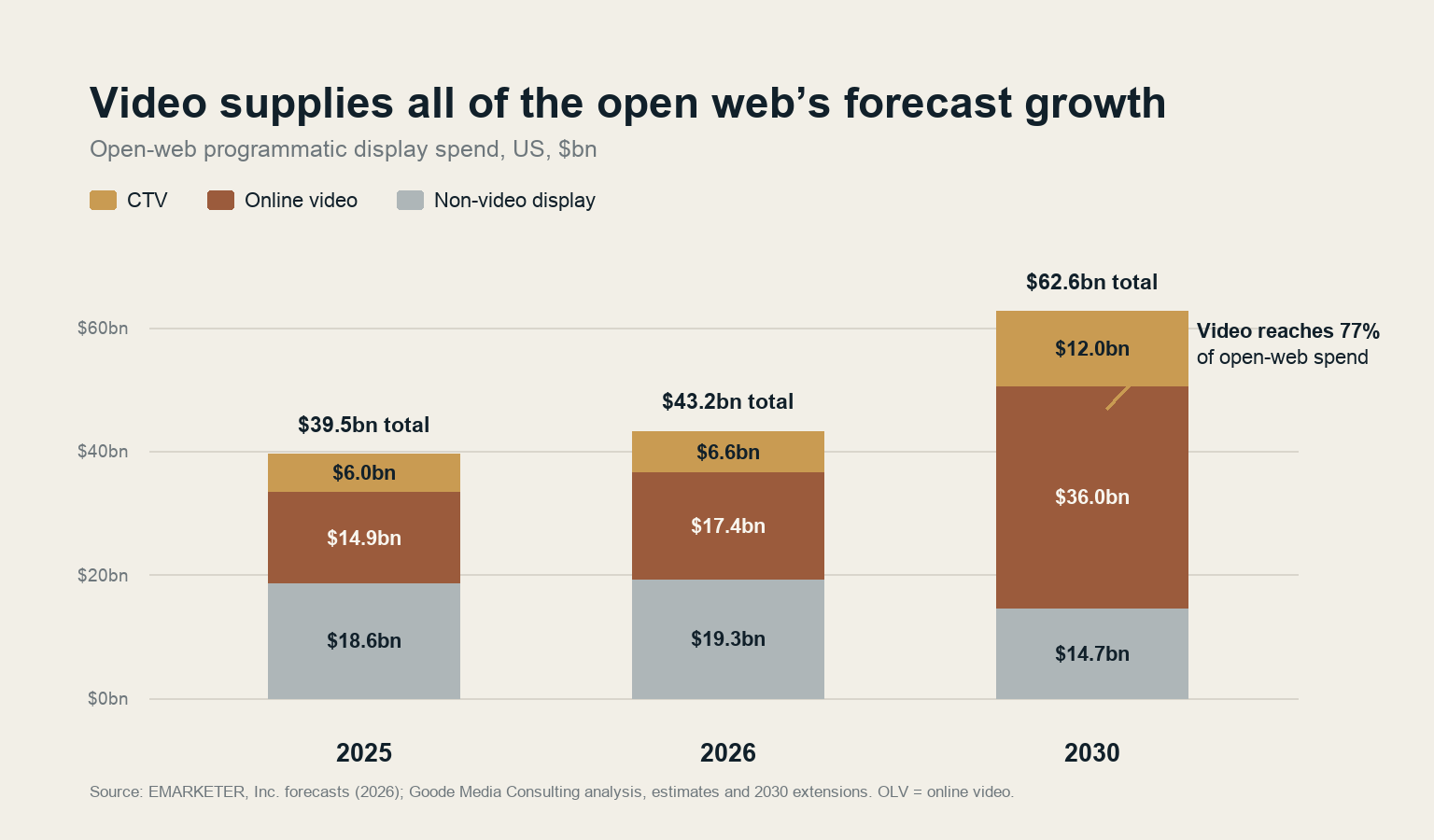
Video is 55% of open-web programmatic in 2026 and 77% by 2030. In dollar terms, video adds $24.1 billion while the total open-web market adds only $19.4 billion, because non-video display gives some of the gain back.
That has practical consequences. A company can operate in a growing open-web market and still be sitting in the shrinking part of it. Products built around display inventory, browser identity and banner-era workflows won’t automatically follow the category upwards. The video market also brings different supply, measurement and commercial relationships. Adding a video tab to the product probably won’t cover it.
The 2030 version
I don’t think this forecast says the open web is dying. A $63 billion programmatic market plus roughly $18 billion of publisher-direct spend remains substantial. Independent publishers will still matter and advertisers will continue to need alternatives to the largest platforms.
It does say the market becomes more video-led and the competition for each incremental dollar gets harder. Open-web companies will need a better answer to why money should move towards them when the easiest growth is elsewhere. For some, that answer will be superior inventory or evidence of outcomes. Others will need to own more of the intelligence behind the decision, which is where my earlier work on the market’s acquisition pattern comes back into view.
The exact 2030 totals will move as new forecasts arrive. I’ll update the model when they do. For now, the useful point is quite ordinary: the open web can grow, remain strategically important and become a smaller part of the market at the same time. The banner isn’t about to disappear. I just wouldn’t build the plan around it doing much of the growing.