
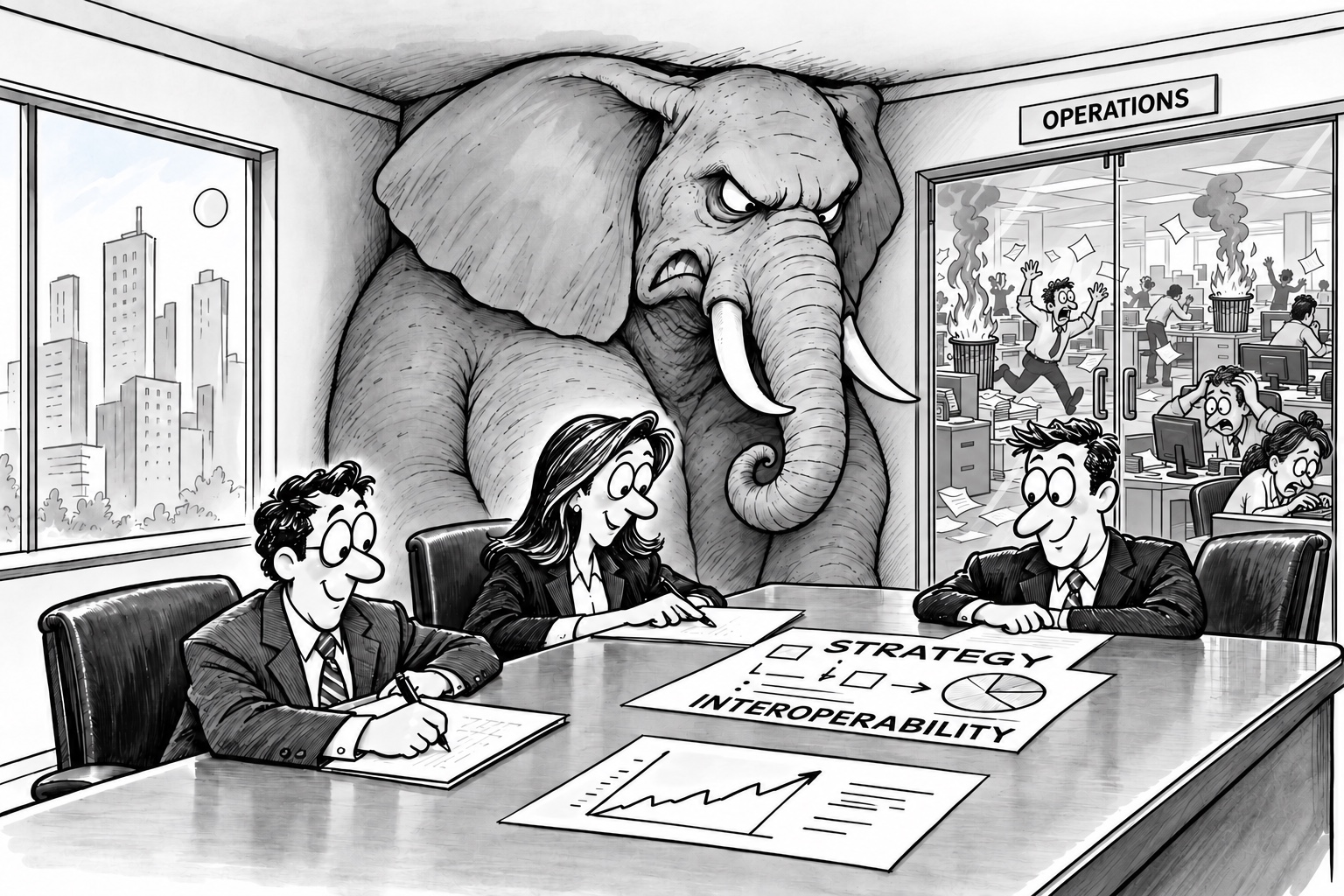
The market is focused on connecting agents between companies, while the internal joins between systems, data and workflows are still being managed by hand. That is where agentic can release capacity for growth.
Agentic interoperability should start inside the business
If “interoperability” is on your bingo card this year, then you scored big. If “agentic” is also on there, well, you just won adtech. Last week I wrote about the amount of M&A happening across buyers. Then Freestar announced that Stagwell had acquired them. I felt validated. Thank you, Stagwell.
For all of you who have sat in executive planning meetings recently, how much of the product strategy has been about how we connect to company X, or how to communicate to the market quite how amazingly interoperable we are?
I get it. You need to be relevant, you need to signal that you are on the AI train and you need to show that the company is looking towards the future. However, there is a two-ton elephant sitting in the corner. It is eyeing up this strategy and will trample it if you don't deal with it first.
Can your own systems communicate with each other?
Adtech already lives in an automated world. Programmatic is inherently automated because no human can make billions of decisions every second about which bid to accept and how to route it. We have spent years automating the market-facing transaction while leaving an extraordinary amount of the work around it to spreadsheets, email, manual reconciliation and people copying information between systems.
Being accessible to other market participants is obviously useful. The IAB Tech Lab's agentic roadmap is sensibly building on OpenRTB, AdCOM, OpenDirect, VAST and the other standards the market already uses, with MCP and agent-to-agent connections sitting on top. We need that common language if agents are going to transact across companies.
But a common external language doesn't fix what happens behind the front door.
As adtech verticalises, which is often what happens as a market matures, companies are bringing more identity, data, measurement, creative, curation, activation and commerce capability into the same organisation. Each acquisition can make complete sense on its own. Put them together and you can end up with a Frankenstein’s monster of user interfaces, databases, workflows, client definitions and reporting structures.
Think of the private equity firms assembling platforms, the agencies pulling more capability into their own operating systems, and the independent companies adding products to defend their position. They are all sitting on a mountain of technology that was never designed to work together.
Just in the past week I have had several conversations where the immediate need is much more basic. Data arriving in the business needs to reach the correct system. Reporting needs to reflect what the client, finance team and platform each think has happened. Product usage needs to find its way back into the commercial conversation. And, let's not get started on CRM systems.
MuleSoft's 2026 survey of 1,050 IT leaders found that the average organisation was managing 957 applications, with only 27% connected. 82% put data integration among their biggest AI challenges, while 86% said agents could add more complexity without proper integration. An agent doesn't remove that complexity simply because it can call an API. If the customer has a different name in the CRM, billing platform and reporting database, the agent still needs to know that they are the same customer. If revenue, spend and margin mean different things to different teams, faster access to the data just produces the wrong answer more quickly.
If no one owns the permissions or the exception process, the agent has nowhere useful to go when something doesn't match.
Some of the larger agency groups understand this. Publicis has described CoreAI as a single layer connecting its data across consumer profiles, campaign performance, content and business transformation. WPP has made WPP Open central to a wider attempt to simplify its operating model. Its 2025 annual report said 71,000 staff, around 90% of client-facing employees, were using the platform regularly. WPP was also quite direct in saying that excessive organisational complexity and the absence of an integrated operating model had contributed to underperformance. This is the crux of the argument...the platform, the data and the organisation have to move together.
If a rule can reliably move a field from one database to another, use the rule. Agentic systems become useful where the work involves interpreting inconsistent inputs, finding context across systems, choosing a route, handling an exception or deciding when a human needs to step in.
Every CEO is now asking how to make their business more AI-forward, while quite a lot of the answer is already sitting in software the company has licensed. Claude Enterprise can connect to internal tools and data through MCP, retaining the permissions of the individual user. Skills can encode a company's own instructions and workflows so people don't have to explain the same process every time.
So why isn't this being addressed more often?
Buying the licences is the easy bit. The work starts when somebody has to decide which system is authoritative, who may approve an action, which exceptions need a person and which process should disappear altogether. This is then where the problem crosses technology, operations, finance, legal, product and commercial departments. Everybody owns part of it but in most cases nobody naturally owns the join.
It is also easier to announce an AI product than remove an internal process. The product has a name, a launch date and something to demonstrate. The time spent reconciling reports, correcting CRM records or finding the right version of a client brief is spread across hundreds of people. It rarely appears as one line on the profit and loss statement, even though the cost and the lost capacity are real.
Tools such as Claude don't walk into a business and resolve those choices. It is a leadership job to choose the workflow that needs attention, agree the source data, set permissions and give someone ownership of the result.
• In an adtech business, that could start with a campaign moving from the commercial team into operations. An agent can read the brief, check that the customer, budget, inventory, creative, data rights and measurement requirements agree across systems, then flag what is missing before anything goes live. It shouldn't invent the missing answer. It should know who owns it and route the exception.
• It could reconcile platform delivery, client reporting and finance data before an invoice is created. Rather than giving someone three spreadsheets and asking them to find the problem, it can identify the variance, show the source records and send it to the person authorised to resolve it.
• It could connect product usage with the CRM so the account team can see that a client has stopped using a feature, increased activity or is repeatedly encountering the same service issue. It could assemble the evidence around an incident from support tickets, system logs, commercial commitments and service levels, without pretending it should make every decision itself.
None of this is especially glamorous. It is also where a lot of money and time disappear and where human capital gets trapped. The case for internal interoperability isn't simply that it reduces cost. If a campaign moves from brief to launch faster, revenue starts earlier. If reporting is reconciled in hours rather than days, the client conversation improves. If account teams aren't fixing CRM records or searching for information, they can spend that time with customers. If product and service teams see the same recurring issue, they can fix it rather than repeatedly explain it. This is why I frequently argue that the efficiency argument is a growth argument that require investment consideration as much as the next sales hire. Better speed, customer service and organisational capability come from moving people away from administration and towards decisions, relationships and products that create value. I would start with the joins that people are already performing by hand. Measure how many times a campaign is touched before launch, how long reporting takes to reconcile, how many CRM records are duplicated, how quickly an exception reaches the right owner and how much activity each person can manage without service declining. An agent can observe first, recommend next and act only when the decision and the limits are clear.
The external interoperability work still matters. Agents will need to discover other systems, understand what they are allowed to do and pass information between companies safely. But connecting two companies before either has resolved its own definitions, permissions and workflows creates a larger surface area for mistakes.
If you are going to invite other systems into your house, get your own house in order first.
An agent that can reach every partner in the market but can't tell which account owns the revenue, which report is correct or whether the client approved the change isn't interoperable. It is just faster at making a mess. Get it right internally and the same growth can be serviced with fewer errors, better customer conversations and more time spent on the work that creates the next piece of growth. That is where I would apply agentic first.