
Transparency is one of those subjects adtech has discussed for years without ever quite resolving.
Everyone supports it in principle. The conversation becomes rather less comfortable when transparency means showing fees, margins, auction mechanics or why one route was chosen over another.
And then somebody asks the reasonable commercial question: what is the upside? If transparency does not win business, why expose information that could create difficult conversations or limit margin?
I understand that argument. I just do not think it is the whole answer.
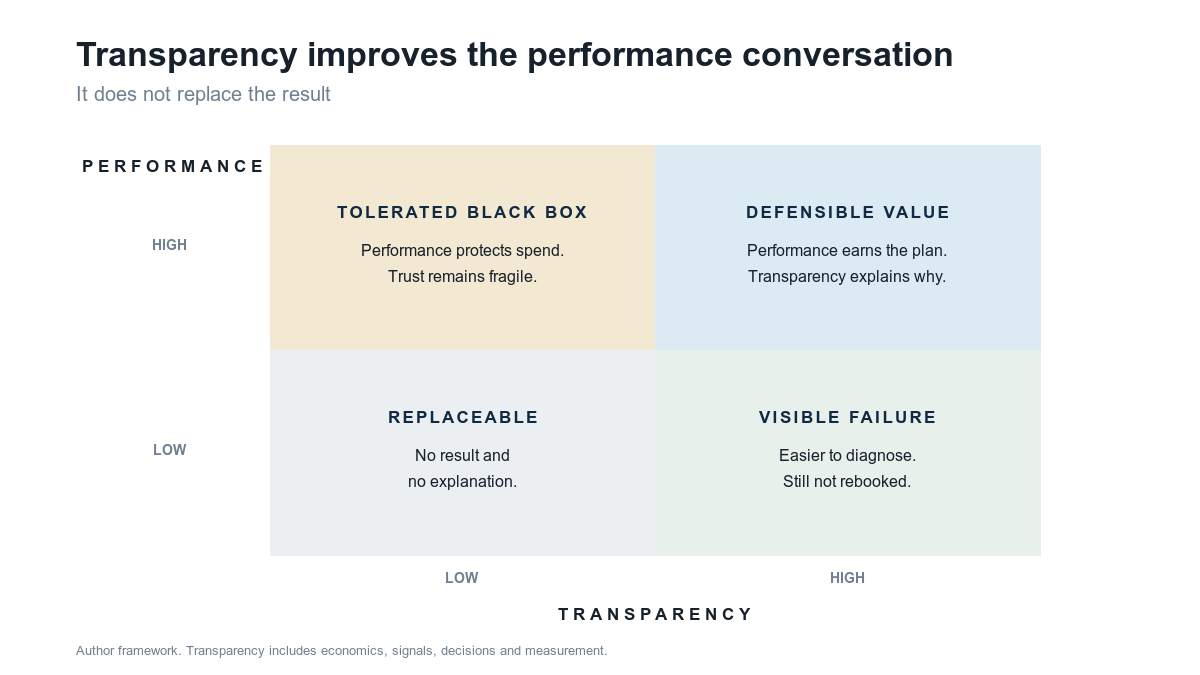
When I was at Havas, we put fee transparency into practice so clients could understand the technology cost and where their money went. It did not replace the need to perform. If the media did not deliver, the client was not going to rebook it because we had produced a particularly honest cost breakdown.
Performance wins the plan. Transparency makes the performance easier to understand, test and improve.
The fee is only part of it
The conversation has often treated transparency as another word for fee disclosure. Fees matter, particularly when the same impression can travel through several routes with different intermediaries and economics.
But knowing the fee does not tell you whether the company added value.
Nobody asks Apple to disclose the margin on an iPhone before buying one. The customer can judge the product, the price and whether it does the job. That comparison is used frequently to argue that adtech should work the same way.
The problem is that much of programmatic advertising is more difficult to judge. The underlying media can be available through several paths. Fees may be bundled into the price. Signals can disappear or change between participants. Measurement may be provided by a company involved in the transaction.
In that environment, the economics are not separate from performance. They can affect how much money reaches the media, which inventory gets selected and which result the system reports.
The Association of National Advertisers found in its 2023 supply-chain study that 71% of advertiser spend reached publishers, but poor-quality media reduced what it called “TrueAdSpend” to 36%. The lesson is not that every intermediary fee is waste. It is that cost and quality have to be examined together. Read the ANA study.
Transparency is moving beyond fees
Recent moves from the buy side caught my attention because they broaden the idea.
Viant's Publisher Solutions gives publishers information about how their inventory appears to its buying platform, including signal coverage and the factors that affect eligibility for demand. Viant explicitly links that visibility to better monetisation and advertiser performance. Read Viant's announcement.
The Trade Desk is moving in a similar direction. PubDesk shows publishers spend trends, buyer-valued signals and supply-path efficiency. OpenSincera makes publisher-level ad-experience metadata available more broadly, including ads-to-content ratio, page weight and refresh behaviour. Explore PubDesk and OpenSincera.
These are company claims, not independent proof that the products will improve publisher revenue or advertiser outcomes. The direction is still interesting.
They treat transparency as usable information rather than a moral statement. Publishers can see which signals reach the buyer, how their supply is assessed and where a change may influence demand. That is much more useful than publishing a fee and declaring the job complete.
Performance buys a lot of forgiveness
The awkward counterexample is the walled gardens.
They do not provide the level of visibility many buyers say they want. They continue to attract enormous budgets because they offer distinctive audiences, simple workflows and measurable performance.
Jounce Media estimates that walled gardens increased their share of global non-search digital advertising from 42% in 2017 to 81% in 2025. That does not prove the open internet shrank in absolute dollars, and Jounce notes that some open-internet spend still originates from buying platforms owned by walled-garden companies. It does show how dramatically budget share has concentrated.
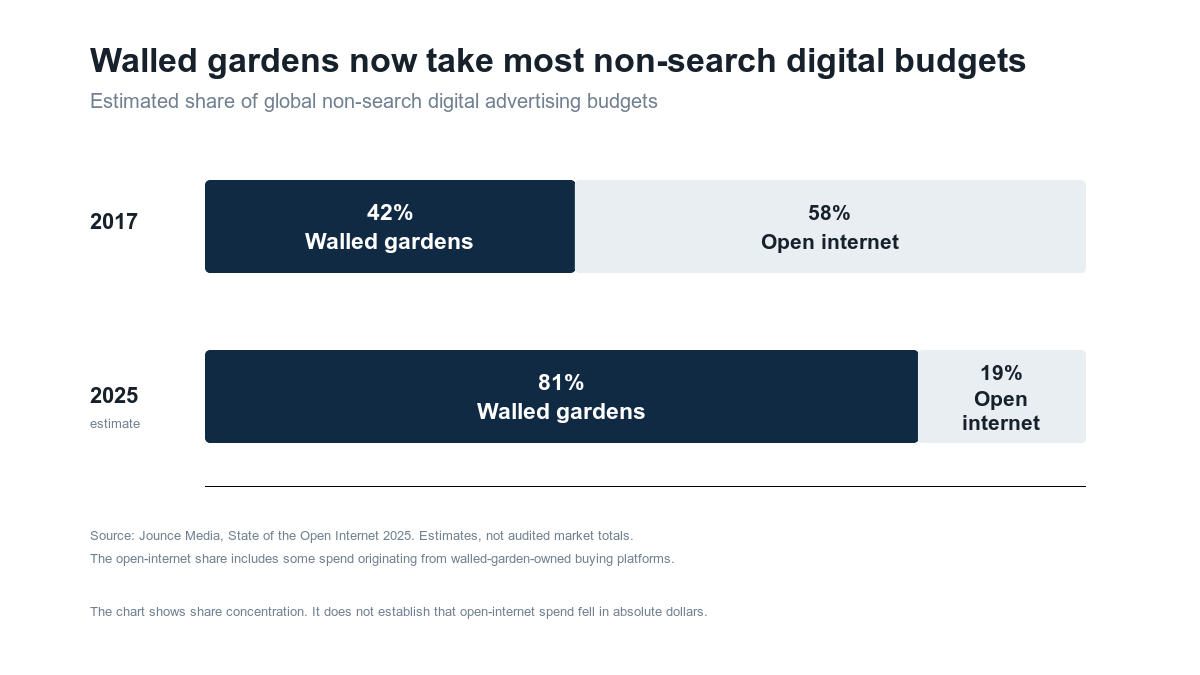
Buyers may dislike the lack of transparency. If the platform continues to deliver an outcome they cannot reproduce elsewhere, opacity rarely becomes the deciding factor.
The open web is different. Much of the supply is available through several companies, and the technology is increasingly commoditised. When the product is less exclusive, trust and evidence matter more.
If two routes appear capable of producing the same result, I would rather use the one that shows me where the money went, which signals informed the decision and how the outcome was measured.
The real fear
I suspect some resistance has very little to do with the administrative burden of disclosure.
Transparency may reveal that the value added is not commensurate with the money extracted. It may show that a performance lever is really a financial lever. It may expose a business that only works when the customer cannot examine the economics closely.
Would that create a competitive disadvantage? Yes, if the business cannot defend its value.
If a company demonstrably improves quality, performance or access, the margin conversation may be uncomfortable but it should be survivable. Customers do not require every supplier to be cheap. They require the price to make sense against the value received.
There is a cost to transparency. It can constrain pricing, expose inconsistency and invite scrutiny. The upside is not always a line on a sales report showing that disclosure won the account.
It creates a more credible conversation when performance changes. It makes incentives easier to understand. It gives customers a reason to believe the company will still behave sensibly when nobody is forcing it to.
Transparency is not the product, and it will not rescue poor performance. But it may be the reason a customer is willing to let you prove the product in the first place.