
There’s a reasonable argument that the open web is slowly losing relevance.
Budgets continue moving towards platforms offering scale and measurable performance. Meta, Google, Amazon and the newer creator ecosystems are certainly easier to buy than hundreds of independent technology companies. Nobody has ever described an open-web supply chain as relaxing.
I’m less interested in another argument about whether the open web is “dead”. Look at what people are buying and a more useful story starts to appear.
In August, Nielsen agreed to acquire DoubleVerify for approximately $2.15 billion, explicitly describing the combination as an independent “media intelligence platform”. Publicis agreed in May to acquire LiveRamp for $2.2 billion enterprise value and described data collaboration as an important capability for AI and “agentic business transformation”. Integral Ad Science had already been taken private by Novacap in December 2025, valuing IAS at approximately $1.9 billion.
Roughly $6.25 billion has moved across three companies associated with identity, measurement and media intelligence. This isn’t loose change, even by holding-company standards.
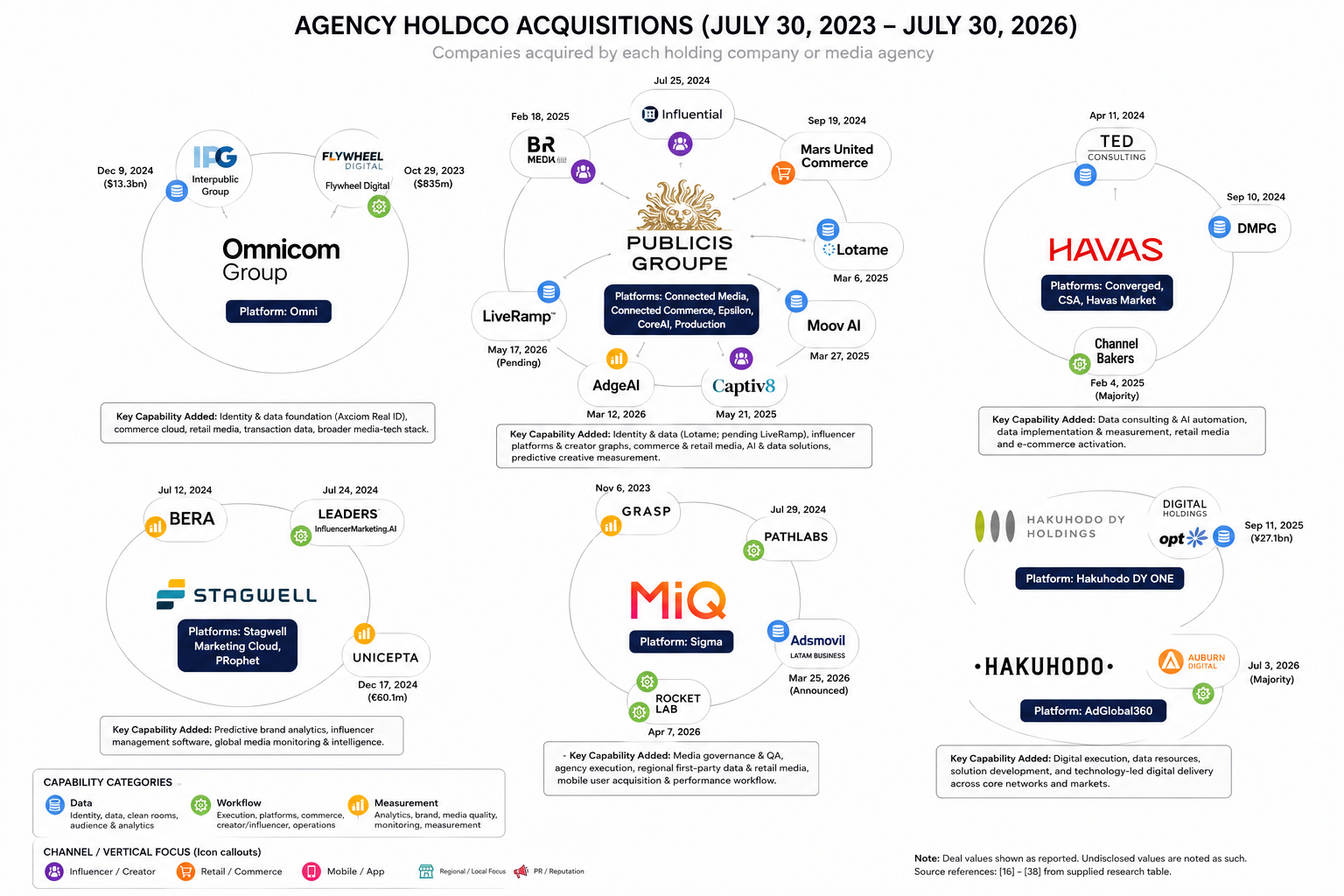
You can explain each deal individually. Perhaps the standalone economics of verification are becoming less attractive. Perhaps public markets no longer reward these businesses appropriately. Perhaps LiveRamp saw consolidation coming and decided scale mattered more than independence. Any of those explanations could be true, but they only tell us why a company might sell. They don’t explain why sophisticated buyers want to own them.
Follow the buyers
Publicis provides the clearest example. Before LiveRamp, it acquired Lotame, adding identity technology, data and more than 1.6 billion IDs. Publicis explicitly connected that acquisition to CoreAI and its ability to connect data with consumers.
Publicis then acquired AdgeAI in March 2026. AdgeAI analyses creative engagement and conversion data, identifies which creative elements work and turns those signals into recommendations. Publicis described it as predictive measurement designed to improve business outcomes.
Identity → data → measurement → prediction → decisioning → activation. It looks less like a collection of miscellaneous acquisitions and more like an operating system.
Publicis isn’t alone. Stagwell acquired BERA, whose technology predicts brand performance and connects brand investment with business value, and later added UNICEPTA’s media monitoring and analytics. Havas acquired TED Consulting for AI-powered automation, then DMPG for data, analytics and marketing-technology implementation. Havas puts those capabilities inside its wider Converged strategy. The routes vary, but the purchases are clustering around the same part of the market.
Closer to the decision
Advertising spread its intelligence all over the supply chain. Agencies planned, data companies found audiences, verification companies judged inventory, DSPs optimised bidding, SSPs understood publishers and the measurement companies arrived later to tell everybody whether any of it worked. Each business held a piece. We got an enormous AdTech ecosystem and, as a complimentary extra, an enormous amount of complexity.
AI changes the economics because it’s becoming easier to connect datasets and turn scattered signals into a decision. Simply owning another piece of information becomes less valuable. Combining the information into a judgement about where a client should spend money becomes more valuable, especially if you also own the tools needed to act on it.
The consolidation story
The open web can remain large while the independent AdTech layer around it gets considerably smaller. Consumers will keep visiting independent publishers and advertisers will still want those audiences. Large publishers will continue building valuable businesses outside the major platforms.
Watch the technology sitting between advertiser and publisher. An intermediary built mainly to provide a piece of information is exposed when somebody else can incorporate that information directly.
It also explains the agency investment. Holding companies don’t need to recreate Meta in its entirety (which would be quite an expensive side project). They need enough of its advantages to connect data with measurement, make a decision and execute it simply.
The result behaves more like a walled garden without necessarily owning the media. That’s a very different kind of holding company from the one assembled around agency disciplines and office locations.
What gets bought
AdTech still tends to discuss competition within familiar categories. DSPs compare themselves with other DSPs. SSPs do the same. Verification companies watch their direct peers, because that’s how the market has always drawn the boxes.
Those boxes obscure where value is moving. The important competition is over who supplies the intelligence that determines what gets bought. Execution isn’t worthless after that decision: scale, latency, auction technology and financial infrastructure remain difficult. It does, however, receive an instruction formed somewhere else.
This is why the recent M&A activity interests me more than another debate about whether programmatic is growing three or seven per cent. The largest participants are buying the ability to understand the market, value an opportunity and make the decision. I’d pay attention to that.